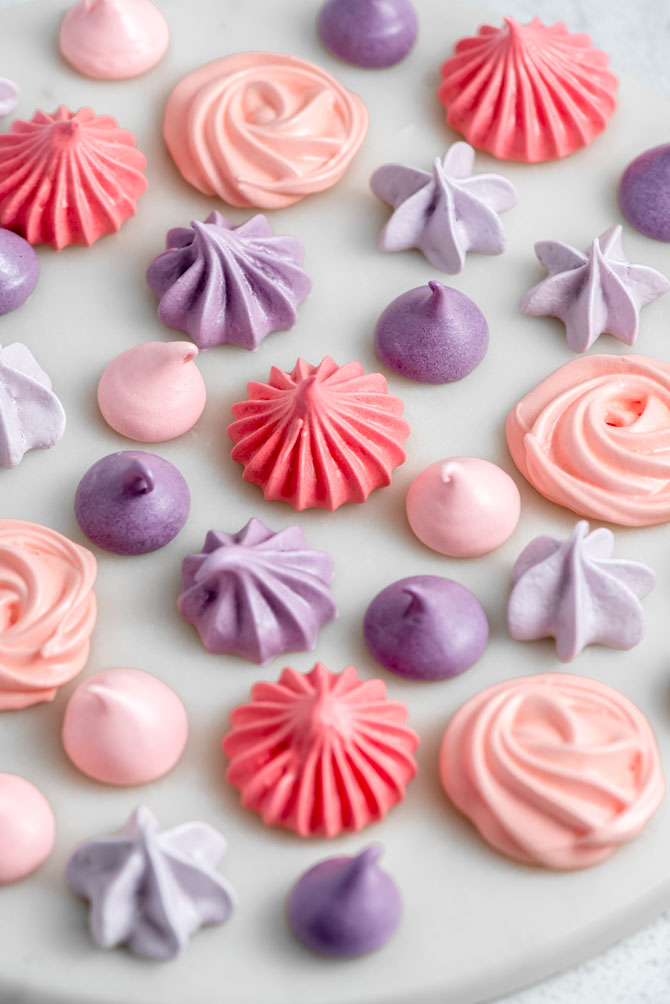
All meringue is fundamentally made from egg whites and sugar, but the method of preparation determines its stability. Stability is all about how resistant the meringue is to moisture which determines how well it holds its shape. There are three different types of meringue, each made in different ways and with varying degrees of stability. Italian meringue is the strongest and most stable type.
Thanks to its stability, Italian meringue is great for all kinds of meringue scenarios–whether you’re baking meringue kisses or pavlova, toasting meringue for pie topping, or using it raw. It also serves as an excellent base for meringue-based buttercreams, such as Italian meringue buttercream. This is why italiain meringue is my go-to meringue, and I can always count on it for fantastic results!

Making Italian meringue requires just a few simple steps, but you will need some special equipment:
Thermometer
You need a thermometer that can measure at least 150 °C (350 °F), such as a candy thermometer. It’s crucial to measure the temperature of the meringue’s sugar syrup because it needs to reach exactly 116 °C (240 °F). Only at this temperature does the sugar achieve the right form to create a stable meringue when added to the egg whites. If the sugar syrup is too cold, the meringue won’t have the necessary stability to hold its shape, and if it’s too hot, it will cook the egg whites!
Stand mixer with whisk or hand mixer
Meringue needs to be whisked for some time, so you will need some power behind it. Trust me, whisking meringue by hand is a losing battle!
Making Italian meringue requires a few simple steps. See the full ingredients and instructions in the recipe card further down on the page.
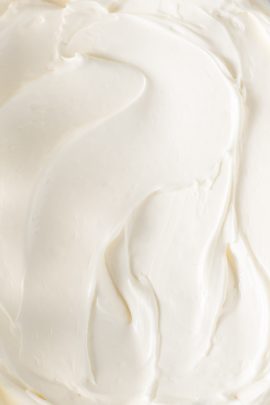
First, boil a sugar syrup to 116 °C (240 °F). Meanwhile, whip the egg whites until stiff peaks form. Slowly pour the hot sugar syrup into the egg whites while continuously whisking. At this point, you can also add any powdered flavorings (like vanilla or cinnamon) and color. Finally, continue whisking the meringue until it cools down and the bowl feels just warm to the touch. Then it’s ready to use!
Tips for making Italian meringue
Here are some important tips to ensure your Italian meringue turns out perfectly:
- Be patient and let the sugar syrup cook slowly under good control until it reaches exactly 116 °C (240 °F). Use a thermometer to check the temperature as it cooks.
- Pour the syrup very slowly into the egg whites while whisking. If you pour too quickly, you’ll end up cooking the egg whites, resulting in a bowl of scrambled eggs instead of meringue!
- Keep whisking the meringue after adding the syrup until the bowl is just lukewarm to the touch. Only then will the meringue be ready to use and hold its shape best.
Just like any other type of meringue, Italian meringue can be baked. It can be piped onto trays lined with parchment paper and placed in the oven at a low temperature for several hours to dry out. Learn all about baking meringue here.

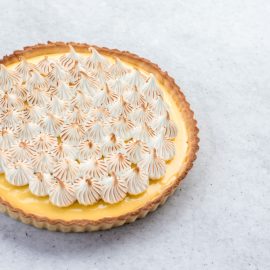
Italian meringue is perfect for toasting because it’s so stable. It can hold its shape for days without absorbing too much moisture and collapsing. This means you can add meringue onto your dessert well in advance, though I always recommend doing it at the earliest the day before serving. The toasting doesn’t affect the meringue’s stability, so you can do that whenever it suits you—but it’s always impressive to do it in front of your guests when serving your beautiful dessert!
To toast the meringue, you’ll need a butane torch. While you could use the grill setting in the oven in a pinch, it’s really risky because you lack the same level of control as with a torch. Meringue burns quickly and can turn black in no time, which doesn’t taste good at all!
Set the torch to medium heat and quickly pass it over the meringue to give it color. You can repeat this process if you want a darker toasting.

Because Italian meringue is so stable, you can make it ahead. Store it in an airtight plastic container or cover a bowl with plastic wrap, and it will keep for up to 3 days in the fridge.
Italian meringue can be frozen, either raw after whipping or after it’s baked. However, there is a small risk that it can get freezer damage. This risk is highest if the meringue is raw, as condensation can make it unstable. That’s why it’s essential to store it in an airtight bag or container in the freezer.
Frozen baked meringue freezes really well in airtight containers and thaw really quickly.
How to freeze Italian meringue
- Meringue should be completely cooled before placing it in the freezer. The best method is to put it in a piping bag, ensuring all air bubbles are pressed out, and then place it in the freezer. Take it out the night before you need it and let it thaw in the refrigerator.
- For baked meringue, such as meringue kisses or pavlova, freeze them individually on a baking sheet lined with parchment paper. Once frozen, you can transfer them to an airtight container and keep them in the freezer for up to 10 months. A few hours before you need them, take them out and let them thaw on the kitchen counter.

 Time: 30 minutes
  Yield: 7 dl*


